PRODUCT CATEGORIES
LATEST NEWS
CONTACT US
Tel:+86 158 5814 7667
Fax :+86 158 5814 7667
Mobile:+86 158 5814 7667
Email: info@dvb-iptv.com
Skype: Wechat: leo5877
Whatsapp: +8615858147667
What are the differences between 16-QAM and 64-QAM modulation?
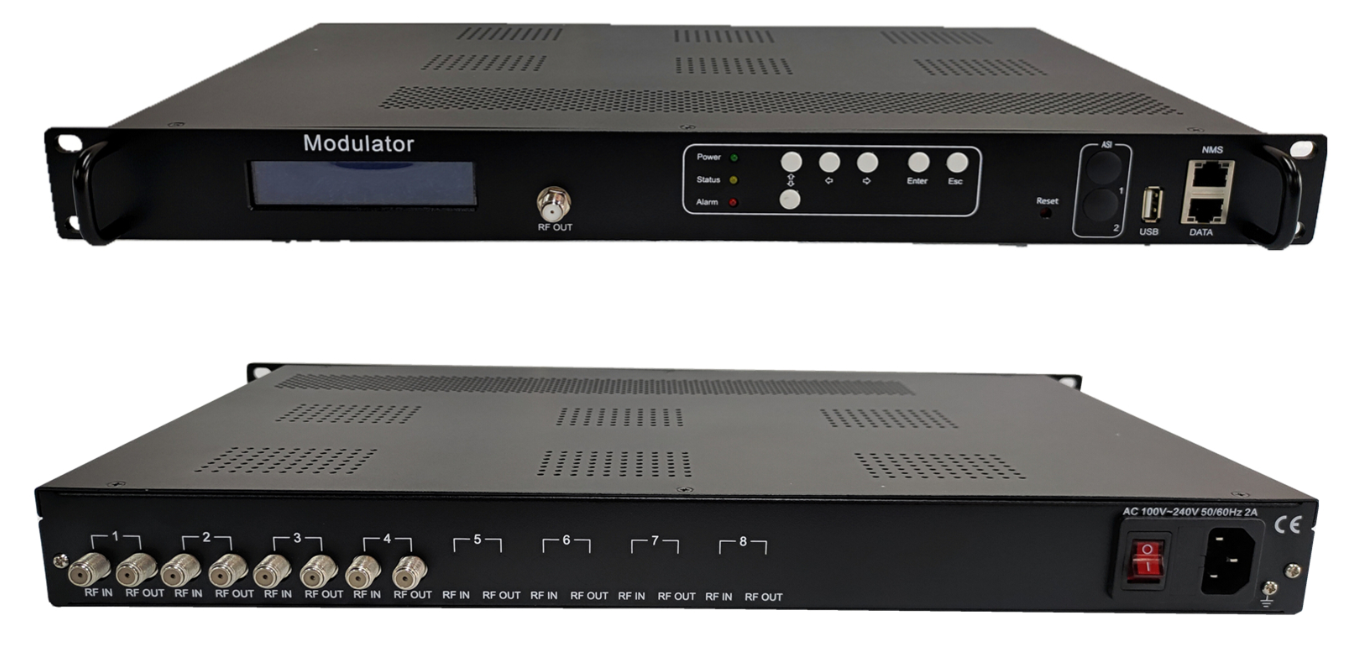
In digital communications, Quadrature Amplitude Modulation (QAM) is essential for transmitting data efficiently by adjusting a carrier wave's amplitude and phase.
Among the many QAM formats, 16-QAM and 64-QAM are particularly common, each offering distinct benefits depending on the application.
As a provider of QAM modulators, I’d like to walk you through their key differences to support your system design choices.
QAM Basics
QAM works by merging two amplitude-modulated signals into one channel, effectively boosting bandwidth usage.
Data is represented as points on a constellation diagram—the horizontal axis for the in-phase (I) signal and the vertical for the quadrature (Q) signal.
The number in QAM (like 16 or 64) indicates how many constellation points exist. For 16-QAM, there are 16 points, each carrying 4 bits (since \(2^4 = 16\)).
In 64-QAM, 64 points allow each to hold 6 bits (\(2^6 = 64\)).
Constellation Layout
A clear distinction lies in the constellation density. 16-QAM features 16 well-spaced points, making symbol identification easier and reducing detection errors.
Meanwhile, 64-QAM packs 64 points into a similar space, resulting in a tighter cluster. This density makes symbol recognition more sensitive to signal distortion or interference.
Data Rate and Bandwidth Efficiency
Data rate is a key consideration. With 64-QAM, each symbol transmits 6 bits versus 4 bits in 16-QAM, so at the same symbol rate,
64-QAM delivers a 50% higher bit rate. This also boosts spectral efficiency—more data can fit within the same bandwidth—which is valuable in spectrum-limited environments like dense wireless networks or satellite links.
Resistance to Noise
However, 64-QAM’s advantages come with greater vulnerability to noise.
The closely packed constellation points mean that slight interference can push a signal into a neighboring point's zone, raising the bit-error rate (BER).
In contrast, 16-QAM’s more spread-out points offer a buffer against noise, ensuring steadier performance in challenging conditions like weak signals or high electromagnetic interference.
By understanding these trade-offs, you can better match the modulation scheme to your specific communication needs.